With the increased power of the Lipo battery (3S 11.1V, 2100mAh) I decided to give Oregon Scientific ATC2000 a second try. I used the rubber band helmet mount and some Velcro to secure it to the battery door. If you bend the landing gear in a bit there is just enough clearance between the camera and the ground. The full up weight with the camera is around 32oz. I of course chose a windy day to try this, but what can you do, its always windy! The take off was a little wild but once I got it under control it flew very nicely. It of course flies much heavier which means you need more throttle to maintain altitude and a longer roll out for take off. Landing wasn't too bad, I kept about 1/4 power almost all the way in and killed it just before landing. This was also in part to the strong wind I was landing in.
Here is the video, the actual quality is better but you tube made it a little choppy:
Sunday, June 1, 2008


Saturday, May 24, 2008
Upgraded Super Cub on a windy day
Today was the first flight of the Super Cub with all the new parts in place. Even though the clouds were ominius and the wind was blowing 10-15 my co-pilot and I decided to press on. For reference my co-pilot is 1.5yrs old but his little fingers are great on the stick ;)
Plane Details:
Stock Motor and Prop
Futaba Pars2 Receiver
Futaba 4 Channel 72Mhz Transmitter (bought TX/RX off Ebay)
Great Planes Electrifly C35 Brushed ESC
2 SG90 9gram Servos (Bought off Ebay from Hong Kong for dirt cheap, $5 each)
Thunder Power 11.1 3C 2100mah Lipo Battery
Deans Connectors
New paint job using foam safe spray paint from my LHS.
The installation of the new eletronics was straight forward with the most coplicated being learning to soldier the Deans connector onto the battery. As the new LiPo battery is larger I decided to put the reciever in the batter compartment and tape the battery in place inside the fusuleage. I may end up switching this around but it will take some modification of the exisint battery box.
The paint job was frustrating and didn't come out quite like I wanted. Though the paint is foam safe I found that it didn't bond very well. Even the gentlist of scratch will chip the paint off. I used the lowest tack masking tape I could find and still it would lift the paint of. I will have to go back and do touch ups on the areas that didn't survive the tape.
Flight Test:
This was the windiest day I have flown to date but let me just say it was fun. The new lipo battery given this plane new life. I don't know how using this battery will effect the motor in the long run as the stock battery is only 8.4V vs. 11.1V. I am trying to mitigate this by not using full throttle very often. I found that 75% throttle was more than enough to rise off ground (ROG) in a short distance. Once airborne into the wind the plane shot straight up and climbed at an incredible (scary) rate. For the first minute or so I though I would completely lose control as the plane gained altitude and bounced around wildly. I looked at my co-pilot sitting comfortably in his stroller and he looked as concerned as I felt. I decided to reduce the power to 50% and I found the plane leveled off and began to stabilize. For the next 15-20 minutes (forgot to record the exact time) I flew a nice pattern slowly on the upwind side and faaassstt on the downwind leg. It was fun playing around with the throttle so the plane basically stood still on the upwind leg. Eventually as with all flights I decided I should stop putting it off and try to land. This was tricky with the wind and I aborted my first attempt. With the old battery I would usually give it full throttle to do a go round, so this time should be no different, right? WRONG! When I applied full throttle into the wind the plane shot up and was almost half way through a loop before I reacted. I figured I had two options, try to complete the loop, or abort....both seemed risk as I was low to the ground and have never done loops at low altitudes. I decided that I would stay with the loop and try to fly out of it. I did this of course knowing that there was a good chance I would hit the ground nose going way too fast. Luckily I made it through and recovered in time to go around and make a reasonably nice landing. I practiced my landings in the wind a few more times and was pleased with the results. A couple of times when I landed harder than I wanted to my co-pilot exclaimed "Uh", leaving out the "O", as he does because he is eccentric (or because he is a toddler). I definitely recommend the LiPo upgrade as it gives the plane much better power and longer flying times. Keep in mind that you have to replace the stock electronics before swiching to a LiPo battery as it is designed for NiMh batteries.


Easy Star with an Oregon Scientific ATC 2000 Camera
I found a deal I couldn't pass up at my local Sharper Image that was closing down. It was an Oregon Scientific (ATC 2000) helmet camera for $60. The normal price is $120 so I was pleased to find a discount. The camera is rugged, waterproof and has an SD card slot. With the included velcro mount the weight of the camera is 6.4 ounces. This is a little heavy for an Easy Star whose weight is 26oz. Never being one to let the pesky laws of physics stop me, I decided to give it try. I decided to mount it in the cockpit sans the cockpit cover. This worked well and kept the CG in place. With nothing left to do but fly I went to the field and gave it a good hand toss. What happened next was quite funny, and unfortunately would have been filmed much better from the ground. The plane climbed about 30 feet or so and almost seemed to stand till, making very little forward progress with the nose pointed up high. The inevitable able happened and the plane stalled, and took a nose dive. In retrospect I should have attempted to land the moment I noticed I wasn't gaining speed. The camera came through unscathed though the nose broke off in the same place as the last crash by my father in law. Luckily it was nothing that a little CA glue couldn't fix. I will have to wait until I upgrade the battery and/or motor before trying this again. Maybe I'll give it a try with the Super Cub? Better buy more glue.....
Thursday, April 24, 2008
Hobbyzone Super Cub Lives!
After many months of trial and error, and replacing every part except the motor and gearbox, the Super Cup flies! My lack of experience accounts for the necessity to replace almost every part, but I learned a lot in the process. In the end it turns out the wing was to blame. Though it looked true I now know the dihedral was off (as a result of crashing several times) which cause the plane to pull hard to the right.
I am in the process of doing a custom paint job so I'll hold off on any pictures until that happens. As I mentioned all the parts have been replaced with stock parts with the exception of the electronics and wheels. I currently have a HiTec Mini 6S 72Mhz receiver and a Great Planes Electrifly C-35 ESC. I went with a higher amp ESC that I really need but I want to be able to use it in the Estes Air Force One when I finally get around to modifying it. I decided to take a chance and go cheap..real cheap on the servos, I ordered a Hong Kong special from EBAY for around 5 dollars each including shipping. They are called SG90 and are have similar specs to other 9 gram servos on the market. They are a perfect fit, and other than being noisy, they seem to work fine. I realize there is risk of failure, but the fact that this plane is very cheap, and that I fly at a field that isn't heavily used, makes me worry less about safety concerns. In my quest to find cheap parts I also picked up an Esky brushed 40A ESC on EBAY for 14 dollars (including shipping). Though it is supposed to have a low voltage cut-off, in my tests it ran the battery so low that the receiver started to cutout and send intermittent inputs to the servos. This isn't a risk I am willing to take so I wouldn't reccomend going cheap on this part.
Initial Flying Impressions:
After flying only the Multiplex Easystar for so long this is really a change. I think the Super Cub is a good step up as its flight chararcteristscs are less glider like and more in line with a regular plane. Its also nice to have wheels to make landings and take offs more realistic.
More two follow after the paint job...
Sunday, January 20, 2008
Estes 747 Air Force One
Among my Christmas gifts this year was a scale Air Force One (foamie) R/C plane by Estes. It is a very nice looking plane and has four brushed Electric Ducted Fan (EDF) engines. The plane is really marketed as more of a "toy" as it comes with a 27mhz controller and no control surfaces. The plane uses thrust vectoring for control, which means the left/right yaw is controlled by powering down the engines on one side or the other. Elevation is controlled by engine speed. Speaking of engine speed, the stock controller only has two speeds, full and 1/2, which is used in turns.
Maiden Flight - Another oddity was the inclusion of an "EZ Launch system", which is a stake and a long bungee to propel the plane forward. For the maiden flight I decided to go by the book and us the bungee. The initial launch went pretty well...at first I thought I would not gain any altitude but it did start to climb. I managed to make a very large turn to the right very low to the ground when I decided to land as I could tell I wasn't going to be able to control it very well. A second flight ended up about the same but I passed way to close to some walkers in the park. I came in for rough landing and popped two of the engines off. Luckily the engines are designed to pop off in a rough landing. The bottom line on this plane in its stock configuration is you need a very large area to fly and no wind. I tried to fly it again a week later with similar results. I have decided to ground this plane pending some upgrades. The plane is to follow in the foot steps of others on the Internet and add ailerons, elevator, new receiver, ESC and a lipo. According to one of the guys at our local field the plane flies nicely with these modifications.


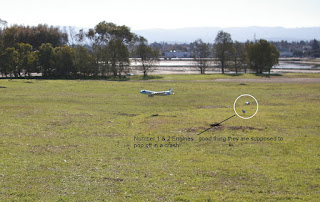
Maiden Flight - Another oddity was the inclusion of an "EZ Launch system", which is a stake and a long bungee to propel the plane forward. For the maiden flight I decided to go by the book and us the bungee. The initial launch went pretty well...at first I thought I would not gain any altitude but it did start to climb. I managed to make a very large turn to the right very low to the ground when I decided to land as I could tell I wasn't going to be able to control it very well. A second flight ended up about the same but I passed way to close to some walkers in the park. I came in for rough landing and popped two of the engines off. Luckily the engines are designed to pop off in a rough landing. The bottom line on this plane in its stock configuration is you need a very large area to fly and no wind. I tried to fly it again a week later with similar results. I have decided to ground this plane pending some upgrades. The plane is to follow in the foot steps of others on the Internet and add ailerons, elevator, new receiver, ESC and a lipo. According to one of the guys at our local field the plane flies nicely with these modifications.


Thursday, January 10, 2008
Super Cub Problems Continue....Easy Star Rocks!!
Before I talk about the Super Cub let me say that the Easy Star rocks! I have had half a dozen or more very successful flights with this plane. The handling properties of this plane are superb and it is very forgiving. I have taken it up quite high with the stock motor, though it does get difficult to tell what attitude of the plane is when it is way up there. Right before Christmas I flew with a couple of guys who are learning on the Easy Star as well. We did a little dog fighting up in the air, chasing each others planes in circles and had some very near misses. Luckily I don't think either one of us was quite good enough to hit each other!
On the Super Cub front....I ordered a new tail and fuselage. I transfered over the stock motor, servos, and Hobby Zone radio system. At this point the only thing which isn't stock is the GWS 10X8 propeller and the Dubro 2-3/4 wheels. Before the maiden flight I trimmed it up, all looked good so I attempted a rise off ground (ROG) take off to give myself a chance to see how it would handle vs. committing to a hand launch. Well, almost a carbon copy of last time. Pull hard to the right. What is going on here? I am just not sure. A couple of things I should have checked (and will when I get time) are the center of gravity (CG) both front to back and left to right. I am really hoping there is a CG issue causing the problem. The other thought I have is possibly the propeller is causing a problem? I read posts from someone who did extensive testing and found the GWS 10X8 to be good. I think I'll throw on a stock prop just to rule that out.
New Toys: Santa was good to me and brought me two new toys. A 2.4ghz wireless camera and an Estes Air force One ducted fan jet. I'll get pictures and stories up when I try them out.
Sunday, December 2, 2007
Latest on the Super Cub
My quest to get the super cub flying continues. I attempted another test flight a few weeks back. The plane barely got 10 feet high with a hand launch when it dove sharply to the right and did a cartwheel. This caused the entire tail to snap off!
After this I realized I needed to go back to the drawing board. I removed the repairs I added a few months back that consisted of large cable ties and dowel rods to secure the battery box. Even without the supports the battery box and landing gear are still secure with CA glue. By looking at other posts on the Internet I determined my electronics problems were probably related to the battery connectors. I snipped off the old connectors and replaced them with new connectors from the electronics store. This seems to have solved the electronics intermittently cutting in and out.
Test Flight:
With the new battery connectors and previous modifications removed, I set out to the park for a test flight. I gave her a solid hand launch and she quickly gained altitude. I was prepared this time for the plane to pull one way or another. Sure enough the plane pulled hard to the right so I countered with left rudder and eventually found that full left rudder barely held the plane straight. A few test flights resulted in the same results. The good news is I was able to keep the plane under control and land safely. After doing some more research I believe the problem is the thrust angle. This super cub is designed with a down and right angle built into the firewall to counter the centrifugal force of the propeller. A few crashes ago I decided to not replace the cracked firewall and just re-glue it. Bad idea! I replaced the firewall and now all I need is some time to give it a test flight!
Subscribe to:
Posts (Atom)